When Sewage Spills: What Bainbridge Residents Should Know—and How to Report It
A sewage spill can begin with a clogged pipe, a stalled pump, or a generator that fails when the power goes out. For Bainbridge Island residents, knowing where to report a suspected release can help agencies respond before pollution travels through drains to the shoreline.
Washington now publishes a statewide sewage-spill list. But understanding those records requires separating three things: routine discharge of treated wastewater, conditionally authorized sewer overflows, and accidental releases.
How Sewage Escapes
According to the Department of Ecology, grease and wipes can obstruct sewer pipes, roots and construction equipment can damage them, and rainwater or groundwater entering the system can overwhelm its capacity. Electrical or mechanical failures can stop pumps from moving sewage to treatment.
Some releases occur before sewage reaches a plant. Others happen when wastewater misses a treatment stage, such as disinfection. During emergencies, operators may deliberately route flow around treatment equipment to limit damage and restore operations. An intentional bypass still counts as a spill of untreated or undertreated wastewater; calling it intentional does not establish that it complied with a permit.
Which Systems May Discharge Occasionally?
Ordinary wastewater permits require treatment and impose discharge limits. Bainbridge’s two municipal treatment facilities appear in Ecology’s records under Winslow, permit WA0020907, and Kitsap County Sewer District 7 at Fort Ward, permit WA0030317. Those listings are not blanket permission to release raw sewage.
A different arrangement applies to older combined sewers, which carry sewage and stormwater in the same pipes. During heavy rain, excess flow can leave through designated overflow outfalls. Ecology says discharge permits for 11 Washington communities and systems conditionally authorize occasional releases of this untreated mixture.
Nearby examples include Bremerton, Seattle, and King County’s system regulated through the West Point treatment-plant permit. The remaining entries are Anacortes, Bellingham, Everett, LOTT, Mount Vernon, Port Angeles, Snohomish, and Spokane. Bainbridge Island is not on Ecology’s combined-sewer-overflow list.
The state’s control standard is no more than one overflow per outfall per year on a long-term average—not permission for any spill, anywhere. Permit conditions and compliance schedules still apply, and violations can lead to enforcement.
The Latest Bainbridge Spill Record
The most recent Bainbridge spill we located concerns a July 15, 2026, incident at 428 Harborview Drive SE. The city’s detailed report estimates that 450 gallons escaped over approximately 12 minutes after a power outage and failure of a backup generator to start.
Sewage emerged through holes in manhole lids. Crews manually started the generator, restoring pumping, and cleaned the parking area, landscaping, and drains. The report identifies Eagle Harbor about 250 feet south, but describes the observed spill as contained to pavement, landscaping, a stormwater catch basin, and a connected building drain. It does not establish that sewage reached the harbor.
Ecology received the report July 17. It carries city incident number 26-2743 and Environmental Reports Tracking System (ERTS) number 748284. No newer Bainbridge spill was found in the accessible records reviewed, but the state’s interactive spill table could not be checked fully. July 15 is therefore the latest documented incident located, not a definitive finding that no later spill occurred.
How to Report a Suspected Spill
For a spill happening now, Ecology directs people to call 1-800-OILS-911 (1-800-645-7911), available around the clock. Call 911 for a life-threatening emergency. The online reporting form is reviewed during weekday business hours and should not delay an urgent call.
To make an online report, open the Environmental Reports Tracking System form:
Choose whether to report anonymously. Enter the incident location, select Kitsap County, and supply an address, nearby landmark, or map link. Describe when it happened, what you observed, and any drains or waterways involved. Add the suspected source and quantity if known; do not guess.
The form accepts a JPG or JPEG photograph. Contact information is optional for anonymous reports; providing an email address brings a confirmation containing the submitted information. Ecology cautions that submitted information is subject to public disclosure.
For follow-up, Kitsap is served by Ecology’s Northwest Region at 206-594-0000 or nwroerts@ecy.wa.gov.
Where to Check for Warnings
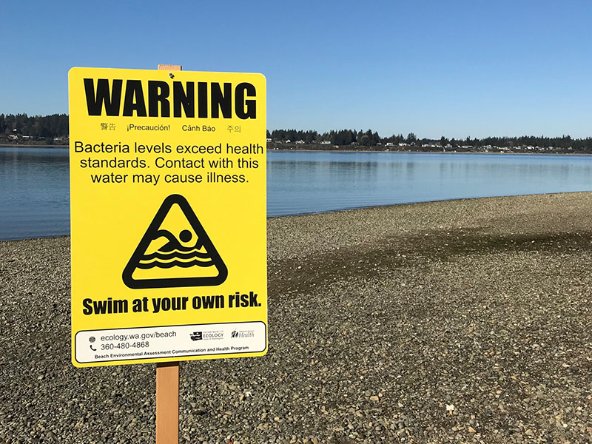
Use Kitsap Public Health’s water-contact advisories for local warnings. Ecology’s spill list covers reports from permitted wastewater facilities after June 22, 2026, but excludes septic systems, illegal dumping, and certain private or unpermitted sewer systems. It aims to post initial information within five working days of receiving a report, so the list is not a real-time all-clear.
Discover more from Bainbridge Island Environmental News
Subscribe to get the latest posts sent to your email.