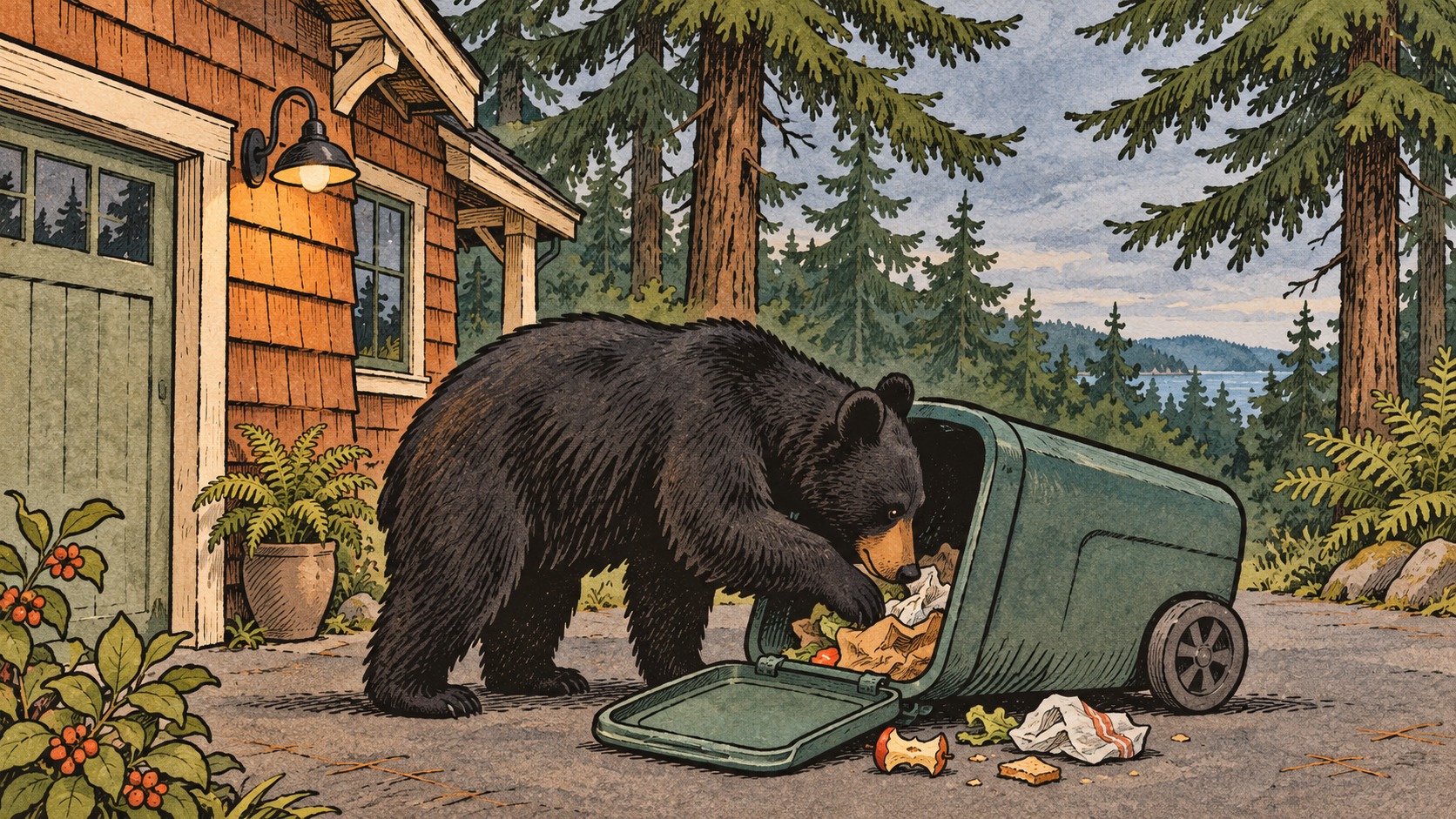
Bainbridge is Bear and Cougar Country. What We Do at Home Matters
“Do we get a plaque or a badge that says this is bear country?” an audience member asked Cole Janowski. The question had a practical point. If islanders understood where they lived, the speaker suggested, they might think differently about how they kept chickens or what kind of garbage cans they put at the curb.
Janowski, a wildlife conflict specialist with the Washington Department of Fish and Wildlife (WDFW), told about 85 people at the Bainbridge Island Senior Community Center on November 12 that the island already qualifies. Its woods and greenbelts are native habitat for black bears and cougars. The whole island, he said, could fit within the territory of one male black bear.
Growing up in Kitsap County, Janowski watched forest give way to housing. The animals that used those woods still need cover and food, and some of the routes they travel now take them past people’s homes. He described hearing from a homeowner who had lived in the same place for 20 years and had owned a doorbell camera for all of three months when it picked up a cougar.
“Cougars have always been there, but now you’re just seeing them because you have cameras,” Janowski said.
A cougar crossing a yard after dark is usually on its way somewhere. An animal that finds an easy meal in that yard has a reason to return, Janowski said. People who feed deer or raccoons draw a cougar’s prey close to home. For a black bear, which eats mostly vegetation in Washington, a feeder full of sunflower seeds offers a lot of calories in one stop.
Janowski reviewed nearly 800 black bear reports in Kitsap County from 2022 through 2025. Among the calls involving a food source, 43% involved garbage and 38% involved bird feeders. A bear that finds a meal at one house can keep coming back or try the next house down the street. That’s why he asks people whose garbage has been raided to tell their neighbors, too.
Keep the garbage in a garage or sturdy shed until the morning of collection, Janowski advised. Take feeders down when bears are active, and bring pet food indoors. Residents who lack a place to secure their trash can ask the island’s Bainbridge Disposal for bear-resistant carts. Some lock upright and open automatically when the truck tips them. Whether Bainbridge Disposal is willing to provide the bear-resistant cans is, however, another matter.
For Wendy Tyner, who organized the talk after losing her four remaining hens near Lynwood Center, the concern was what a bear could get into in the backyard. Janowski recommended electric fencing around coops and securing the feed as well as the birds. For sheep and goats in cougar country, he suggested a roofed enclosure at night. The same four-foot fence that keeps a goat from wandering leaves it penned up with any cougar that jumps in. Cougars can jump over 10 to 15 feet, Janowski said.
One listener wanted to know about the risk to people. “Has anybody ever reported being hurt by a bear?” Attacks do happen, Janowski said, but in roughly three years working in the area he had yet to take a call about a bear attacking a person. On trails, he advised keeping dogs leashed so the dogs do not chase or attack a bear cub. A sow defending her cubs from an unleashed dog is a sure way to provoke and attack, Janowski said. If you round a corner and see a bear or cougar, give it room to leave and back away slowly. Running can trigger a chase.
If an animal poses an immediate threat, Janowski said, call 911 so local officers can respond. For a nonemergency encounter, such as finding that a bear got into the garbage overnight, residents can reach WDFW dispatch at 360-902-2936, option 1.
Some islanders worried that calling would get a bear killed. Janowski said a sighting helps him track an animal, and the details of a report determine how the agency handles it. “A lot of people are skeptical to report it to us because they think the first thing we do is come out and trap and kill something,” he said. “And I’ll be honest, sometimes we have to do that depending on the severity of it. But most of the time that’s not going to be our response.” The harder decision comes when a bear has learned to approach people for food. A release site within reach of a truck and trailer may simply put that bear near another neighborhood. Moving a cougar carries its own risk. It can travel back or be killed by a cougar already occupying the release area.
Janowski had tried relocation himself with a young bear that raided garbage cans and grills near Bremerton. He drove it to Spider Lake in Mason County, as far into the woods as he could get with his trailer. The following June, a father spent hours trying to drive the same bear away from his family’s campsite. It kept coming back for their Cheerios. By then, Janowski said, the bear posed a danger to people, and he had run out of places to take it. He set a second, lethal trap. Once a bear has become that dangerous, he explained, the department may have to kill it.
“I didn’t get in this field to kill animals,” Janowski said. “I do this work to help prevent from ever getting to that point to begin with.”
Earlier coverage: Bainbridge talk to focus on reducing human-wildlife conflicts.
Share this:

Discover more from Bainbridge Island Environmental News
Subscribe to get the latest posts sent to your email.